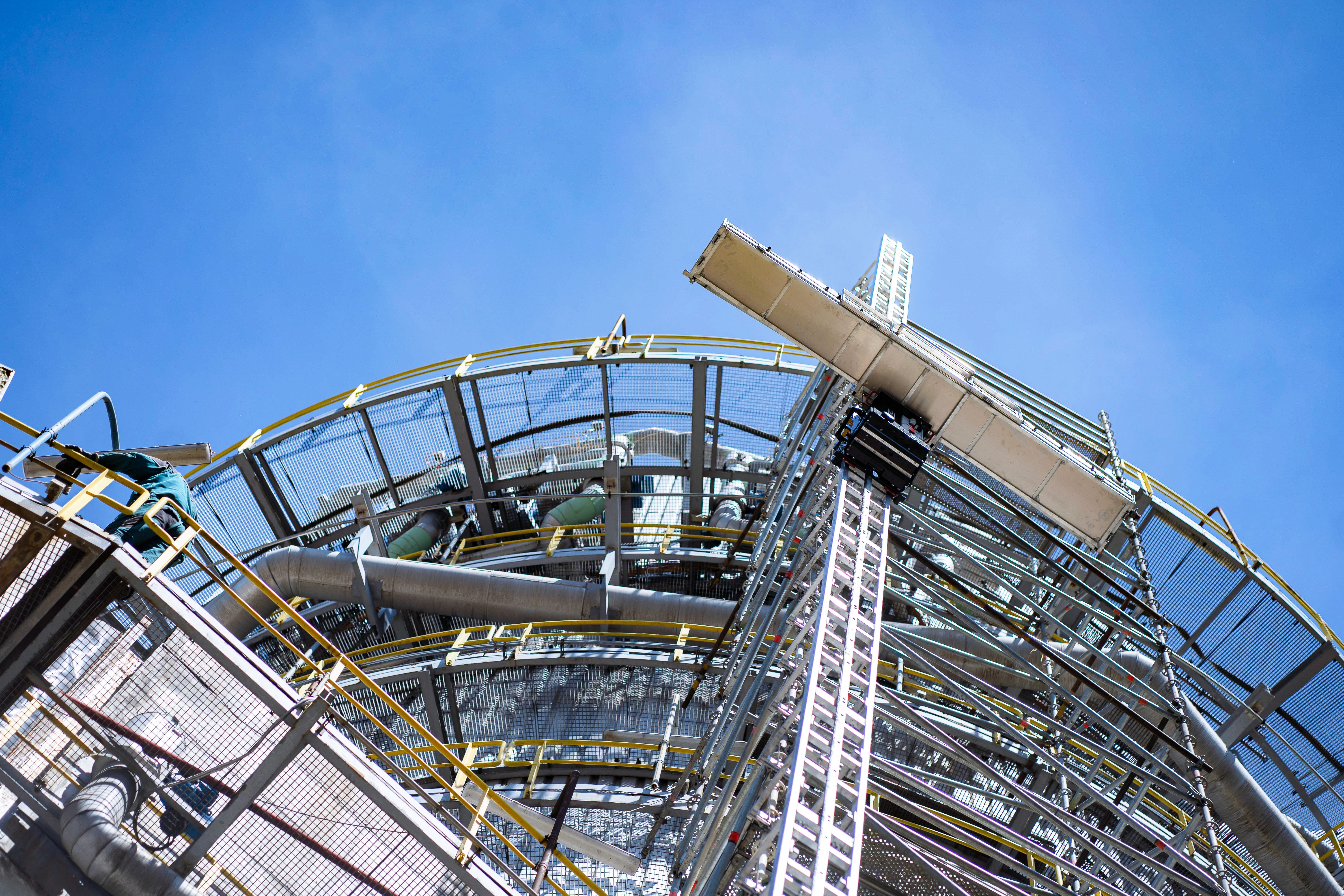
If you are new to LIFTBOT, this section will help you learn more about our material lifting solution.
What is LIFTBOT?
LIFTBOT is a robotic vertical material lifting system designed for industrial maintenance, turnarounds, and construction projects. It replaces cranes and manual handling for repetitive vertical material movement, improving safety, productivity, and project timeline.
How can I test LIFTBOT?
LIFTBOT can be tested through a pilot deployment. Test units are available in North America and Europe. Pilot projects typically run 1-2 weeks and allow site teams to validate performance, calculate savings, and gather feedback from site crews, supervisors, and HSE.
Up to what height is LIFTBOT certified?
LIFTBOT is certified for use up to 165 ft / 50 m. For projects requiring greater heights, KEWAZO’s engineering team can support site-specific assessments. In the past, Liftbot has been used for projects up to 330 feet / 100 meters high.
What loads can LIFTBOT handle?
LIFTBOT is designed for industrial material transport, including scaffolding, insulation, piping, mechanical, electrical and instrumentation, tools, coatings, and other materials. Load cases and technical documentation are provided to support engineering review and site approval.
How does LIFTBOT impact scaffold or structure design?
LIFTBOT is intentionally designed so that scaffold or structure designs do not need to be adjusted due to its operation. All vertical loads generated by LIFTBOT are transferred directly to the ground via the rail system. The horizontal loads introduced into the scaffold or structure are minimal and have negligible impact on structural design.
Which scaffolding system do I need to install to use LIFTBOT?
LIFTBOT is intentionally designed so that scaffold or structure designs do not need to be adjusted due to its operation. All vertical loads generated by LIFTBOT are transferred directly to the ground via the rail system. The horizontal loads introduced into the scaffold or structure are minimal and have negligible impact on structural design.
KEWAZO provides pre-calculated load information for LIFTBOT to support engineering review.
What wind conditions can LIFTBOT operate in?
LIFTBOT is designed to operate in significantly higher wind conditions than cranes.
Typical crane operations are restricted at approximately 10–15 mph (16–24 km/h), whereas LIFTBOT can continue operating in wind speeds of up to 45 mph (72 km/h).
This higher wind tolerance enables continued material transport during conditions that would normally stop crane operations, improving schedule reliability and reducing weather-related downtime during maintenance, turnarounds, and capital projects.
Can LIFTBOT replace cranes?
Yes. LIFTBOT is commonly used to replace cranes for vertical material movement, particularly for repetitive lifts such as scaffolding, insulation, and maintenance materials. Cranes may still be required for oversized or exceptional lifts, but LIFTBOT reduces crane dependency, congestion, and weather downtime.
Can LIFTBOT be used only for scaffolding?
While LIFTBOT was initially developed to support scaffolding operations, it is now used as a general-purpose vertical material logistics system. It transports a wide range of materials including insulation, piping components, mechanical and electrical equipment, tools, coatings, and other project-critical materials - supporting maintenance, turnarounds, and capital projects.
Do I need scaffolding to use LIFTBOT?
No. LIFTBOT does not require scaffolding. It can be installed directly on existing assets, such as steel structures or beams, depending on site conditions and engineering assessment.
Which scaffolding systems are compatible with LIFTBOT?
LIFTBOT is compatible with all common industrial scaffolding systems, including Layher, Ringlock, Cuplock, Safway, PeriUp, Kwikstage, Turner, Frame and Brace, and Tube & Clamp / Tube & Fitting.
How long does installation take?
A typical LIFTBOT installation can be completed in approximately 20 minutes directly by the hands of site people. No heavy lifting equipment - mobile cranes or forklfits - is required for installation.
Can one LIFTBOT serve multiple locations?
Yes. A single LIFTBOT unit can operate on multiple rail locations on the same site. This allows teams to reposition the unit as work fronts change, maximizing utilization.
How long does the battery last?
LIFTBOT operates 8-10 hours under heavy use. Charging takes 2-3 hours from a standard 230V (Europe) or 110V (North America) outlet. Batteries are swappable, enabling uninterrupted operation.
What happens in case of power loss or emergency?
LIFTBOT is a battery-powered system, meaning it does not rely on external site power. As a result, external power loss does not affect safe operation. In the event of an emergency, LIFTBOT has multiple integrated safety systems, including emergency stop functions and controlled, fail-safe shutdown behavior, ensuring safe operation at all times.
Is LIFTBOT ATEX certified?
LIFTBOT is not formally ATEX certified. However, it has been successfully deployed on hazardous industrial sites using site-specific risk assessments and hot work permits, in alignment with standard plant procedures.
What training is required?
KEWAZO provides on-site training conducted by certified service engineers. Training typically lasts 2 hours, covers both theory and hands-on installation, and is delivered in small groups to ensure operational readiness.
Can LIFTBOT transport people?
No. LIFTBOT is designed exclusively for material transport and is not approved for personnel lifting.